

Every business owner gets dealt into the game for the same price: nothing.
Opening an Instagram account? Free! Same for a Facebook business page or a Google Business Profile. A domain name? Set aside the cost of a fast-food lunch. Typing your business name into the same search box your biggest competitor uses? Also, free.
On paper, it’s the most level playing field capitalism has ever handed anyone.
But the free market we all effortlessly enjoy was never a promise of equal outcomes. It’s a promise of equal access.
It’s a promise that everyone gets a seat at the table. It doesn’t promise you’re guaranteed to eat.
Marketing runs on the same logic. The entry fee is close to zero. The price of being legitimately “seen”? Far from it. Confusing the two is how a lot of good businesses stay invisible while lesser competitors outrank them.
The market doesn’t ask what you can afford, and it doesn’t reward whoever shows up loudest for a 30-day streak. It responds to whoever’s earnestly and consistently showing up, six months later. A burst of ad spend, or a budget padded to look bigger than it is, moves next to nothing.
A modest budget invested consistently, and invested honestly, moves plenty and sustains. Moving the needle is not a one-time toll.
The Real Game Is for Attention, and It’s Pay-to-Play
The average person is exposed to somewhere between 4,000 and 10,000 ad messages a day across channels like social feeds, search, billboards, packaging, TV, and streaming. The exact figure fluctuates, but every estimate agrees on the punchline: of those thousands of messages bombarding us, a person consciously registers something closer to 100.
That’s the real currency this game is played for. Every business fighting for the same eyeballs is bidding for a seat inside that number, and getting noticed comes with a price tag.
That price tag gets set the same way every price in an open market gets set: by auction. Google runs one in real time, on every single search, scoring each ad on the advertiser’s bid combined with the quality of the ad and the page behind it, so a sharper ad with a smaller bid can beat a bigger bid with a sloppy one. But you still have to enter the auction to compete for the slot.
Meta runs a similar version for its billions of daily users: hand it a list of even a few hundred of your best customers, and its systems find thousands of strangers who share those same patterns, before those strangers have ever heard of you.
Neither platform is fighting the businesses paying to compete. The algorithm is working exactly as designed, for whoever pays to use it.
What Each Channel’s Buying
Different channels buy different things. Confusing the objective is one of the most expensive mistakes a marketing budget can make.
- Google Search Ads (PPC): a real-time keyword auction scored on your bid plus ad and landing page quality. It buys placement above organic results at the exact moment someone is ready to buy. Bid on a competitor’s brand name and you show up the moment someone searches it, today (not in six months).
- Meta Ads (Facebook & Instagram): enhanced targeting, including lookalike modeling built off your own customer data. It buys instant access to an audience that would otherwise take years of word of mouth to reach. A hair salon with two hundred loyal clients can turn that list into thousands of new local prospects who share those same habits, running ads by the next morning.
- SEO/Organic Search: algorithmic ranking built from relevance, technical health, and authority earned over time. It buys a compounding asset that keeps producing without an ongoing media bill. A well-built service page can generate leads two years later with zero ad spend, but it takes months to rank.
- Organic Social: reach set by the platform’s algorithm and the audience you’ve already built. It buys free distribution, capped by whatever the algorithm decides to show. Still, a $50 boosted post can reach more people instantly than 200 organic followers ever will.
Each channel serves its own purpose, which is why the businesses seeing real ROI are running more than one of them at once.
The businesses paying into these systems aren’t cheating. They’re the legitimate players in the field. Relying on organic alone isn’t a shortcut around paying. It’s opting into the free tier’s timeline and ceiling.
The Funnel, Stage by Stage
Whichever channels fund it, the mechanics still run through the same stages, the ones marketers have used for decades to map a stranger’s path to becoming a customer: Awareness, Consideration, Conversion, and Retention.
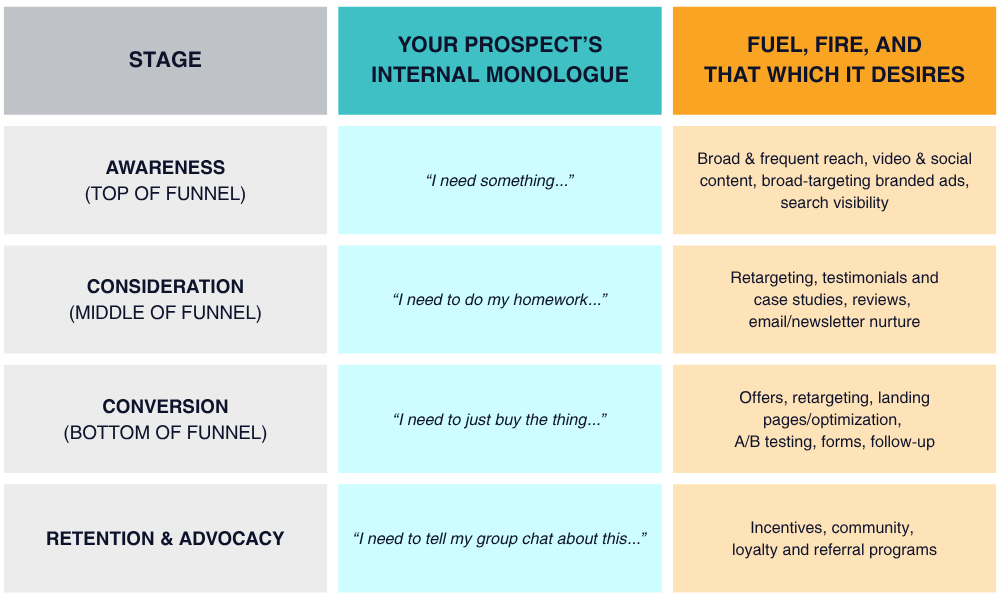
Skip a stage and the entire funnel leaks. A great awareness-stage video with no consideration content behind it just entertains people who’ve forgotten about you by dinner.
And the funnel isn’t always a straight line: a happy customer at the retention stage can become the referral that feeds a stranger back in at awareness, which is why the strongest funnels are built as a loop (not a chute).
Standing Still Costs More Every Year
The stakes go up every year whether you raise your bet or not.
US digital ad spend is on track to hit roughly $413 billion in 2026, up about 14% from the year before, with global ad spend forecasted to surpass $1 trillion for the first time this year.
A budget that hasn’t moved in three years is, in real terms, shrinking. If you choose to skip the investment, you’re inevitably falling behind.
Small Business Owner? Here’s Your Sign
The Small Business Administration recommends businesses under $5 million in revenue put 7 to 8% of gross revenue into their marketing.
Now consider what’s happening in real time.
A recent survey of over 7,400 small businesses found roughly a quarter plan to spend nothing on marketing in a typical month. A separate analysis puts those spending less than $1,000 a year at over 66%; of those same small businesses, 61% have not yet invested in SEO.
“Too much competition” is the reason most owners give for staying cautious, but if two-thirds of the field is playing for free? You’re already ahead of your competition with a legitimate investment. The businesses that show up with an actual budget and structure are fighting a much smaller, much more winnable game than it appears from the sidelines.
Consider the tremendous potential for small businesses. If the plan is to stay “exactly this size,” forgive us for our sound-the-alarm urgency here. But if the plan is to scale? To become the mid-size or regional name instead of the small one? This is the fastest route there.
When most of the competition is still treating their marketing as optional, a small business willing to invest real dollars into a structured system is kicking the competition to the curb, one funded campaign at a time. You show up while two-thirds of the field is still deciding whether to play this week, and the gap between a small business and the name everyone in the area already knows? It closes a lot faster than anyone expects.
Structure Before Spend. Always.
Paying to enter these systems doesn’t guarantee a win. Pair it with deliberate structure, and the odds tilt hard in your favor.
Marketers have argued forever over the “rule of seven,” the idea a customer needs seven exposures to a brand or business before buying. This number’s been picked apart (more recent research puts the real figure closer to three), but everyone agrees on the foundation: familiarity lowers perceived risk, and scattered touches don’t accumulate the way a structured omnipresence does.
Keep in mind, seven random impressions across seven platforms with seven different messages aren’t seven touches at all. They’re one weak touch, repeated. It never becomes a funnel.
That’s the difference between paying for eyes and paying for outcomes. Impressions are cheap to buy and easy to brag about. Leads, qualified conversations, and closed business deals? They’re harder to earn, and they’re the only numbers that actually pay your bills.
A campaign built with intent tracks which channel produced a real inquiry, which message earned a reply, which dollar turned into a customer instead of a data point on someone else’s dashboard. That data makes the campaign trainable: it refines and improves with every cycle.
The return isn’t a function of how much you spend. It’s a function of how deliberately, and how measurably, that spend is put to work.
Real Returns
Marketing should never be treated like a mere expense or line item to shrink when a quarter gets tight. It’s an investment, the same category as inventory or a new hire; investments are judged by what they return over time, not by how they feel in the moment they’re spent.
A follower won’t pay your bills. A month of impressions won’t either. But customers will. The whole point of running paid search, paid social, and SEO together, structured and measured, is to produce more leads, and from those leads, more customers, because these are the only outputs that will actually move your margins.
This is the mental shift that separates the businesses winning this game from the ones still deciding whether to play. It’s the same shift we walk every prospective client through (especially those who are hesitant to go from testing the waters at a hundred dollars per month to committing to a real retainer).
Instead of asking what marketing costs you this month, start asking what it’s building: a pipeline of real leads, a growing base of paying customers, a system that keeps producing long after the campaign that started it has ended.
The seat at the table is free. What you win depends on whether you treat what you put in as a cost to minimize, or an opportunity to grow.
Ready to see what a structured investment can do for your margins? Let’s connect.